


Virtual Deal Room Software Explained: How Deal Rooms Streamline Transactions
“Data room” and “deal room” are often used interchangeably — and in casual conversation, that’s usually fine. But virtual deal room software typically refers to something slightly broader than a document repository: a platform built around managing the entire deal process, not just secure file storage.
This post explains what deal rooms are, how they differ from a pure data room, and what to look for if your team needs software that manages the whole transaction lifecycle — not just document access.
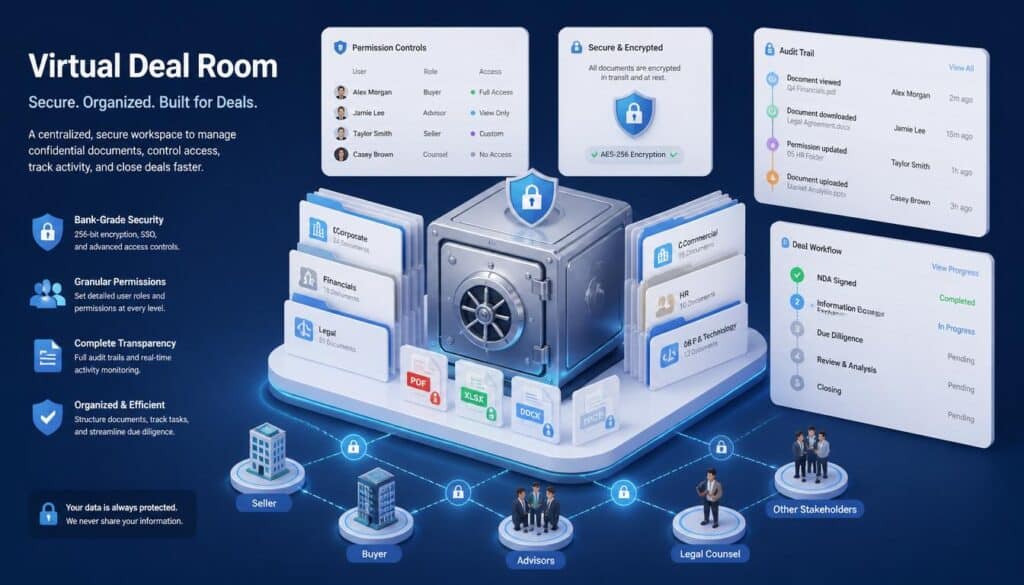
What Is a Deal Room?
A deal room is a secure, centralized workspace where everyone involved in a transaction — buyers, sellers, advisors, lawyers, and internal teams — can collaborate, share documents, track tasks, and communicate, all in one place.
Where a traditional data room is primarily about controlled document disclosure, a deal room typically adds a project-management layer on top: task assignments, deal timelines, pipeline tracking, and progress dashboards that give deal leads visibility into where things stand at any given moment.
Data Room vs. Deal Room: The Practical Difference
The terms overlap heavily, and many providers use them interchangeably in their own marketing. But when there is a meaningful distinction, it usually comes down to this:
| Data Room | Deal Room | |
| Primary focus | Secure document storage and controlled disclosure | End-to-end deal management and collaboration |
| Typical users | Bidders reviewing documents during diligence | Internal deal team plus external stakeholders |
| Core features | Permissions, watermarking, audit trails | Task tracking, timelines, checklists, plus document sharing |
| Best suited for | Single-transaction document disclosure | Managing multiple concurrent deals or complex, multi-stage processes |
In practice, most modern platforms blend both functions. The best virtual deal room software gives you the document security of a data room and the process management of a project tool, without forcing you to stitch together two separate systems.
Why Deal Rooms Have Become Standard for Complex Transactions
Deals rarely fail because of a single missing document. They stall because of poor coordination — a missed follow-up, an unclear task owner, a stakeholder who doesn’t know a deadline moved. Virtual deal room software addresses this directly by giving every party a shared, real-time view of where the transaction stands.
Centralized communication: Instead of critical decisions living in scattered email threads, deal rooms keep discussion, document sharing, and Q&A in a single traceable location.
Task and milestone tracking: Deal teams can assign specific action items — “legal review of Schedule 3,” “finalize disclosure letter” — with owners and due dates visible to the whole team.
Pipeline visibility for multi-deal teams: Investment banks, PE firms, and corporate development teams running several transactions simultaneously benefit from dashboards that show every deal’s stage at a glance.
Reduced advisor overhead: When lawyers, accountants, and bankers can self-serve information inside a well-organized deal room, it cuts down significantly on status-update calls and repetitive email chains.
Key Features to Look for in Virtual Deal Room Software
Beyond the standard data room essentials — permissions, watermarking, encryption, and audit trails — deal room software should also offer:
- Deal pipeline dashboards — visual tracking of every active transaction and its stage
- Task management — assign, track, and close out diligence and closing checklist items
- Templated checklists — standard due diligence or closing checklists you can reuse across deals
- Stakeholder-specific views — different parties see only the tasks, documents, and updates relevant to them
- E-signature integration — move directly from document review to execution without leaving the platform
- Reporting and analytics — track deal velocity, bottlenecks, and stakeholder engagement over time
Common Use Cases for Deal Rooms
Mergers and acquisitions: Deal rooms manage the entire process from initial due diligence through to signing and closing, with checklists and task ownership that keep dozens of workstreams moving in parallel.
Private equity and venture capital: Firms managing a pipeline of active deals use deal rooms to track everything from initial screening to term sheet negotiation across multiple portfolio opportunities simultaneously.
Corporate development: In-house M&A teams use deal rooms to standardize their diligence process across acquisitions, reusing checklist templates and keeping institutional knowledge in one system rather than scattered spreadsheets.
Real estate and infrastructure deals: Complex, multi-party transactions with long timelines benefit from the task-tracking and milestone visibility a deal room provides, on top of standard document security.
Choosing Between a Data Room and a Deal Room
If your need is straightforward — share a defined set of documents with a limited group of reviewers for a single transaction — a focused data room may be all you need, and it’s often simpler and cheaper.
If you’re managing a longer, more complex process with multiple internal and external stakeholders, shifting deadlines, and recurring tasks, virtual deal room software that combines document security with process management will likely save your team significant coordination overhead.
Many providers today let you start with core data room functionality and add deal-room-style project management as your needs grow, so it’s worth checking whether a platform can scale with you rather than requiring a full switch later.
What to Ask Before Choosing a Platform
- Does the platform combine document security with task and pipeline management, or is it document-only?
- Can you create reusable checklist templates for recurring deal types?
- How well does it handle multiple concurrent deals — separate workspaces, shared dashboards, or both?
- Does it integrate with e-signature and CRM tools your team already uses?
- What level of visibility do external stakeholders get into task status versus internal-only tracking?
Final Thoughts
The line between “data room” and “deal room” continues to blur as platforms add more collaboration features on top of secure document sharing. What matters isn’t the label — it’s whether the software genuinely reduces the friction in your specific transaction process.
For simple, document-focused disclosure, a lean data room does the job. For managing complex, multi-stakeholder deals from first contact through to close, virtual deal room software that unifies document security with task and pipeline management will almost always be the better investment.
The Definitive Guide to Virtual Data Rooms (VDRs)
Virtual Data Room Software: Key Features and How to Choose the Ideal Platform
Virtual Data Rooms for Mergers and Acquisitions
