


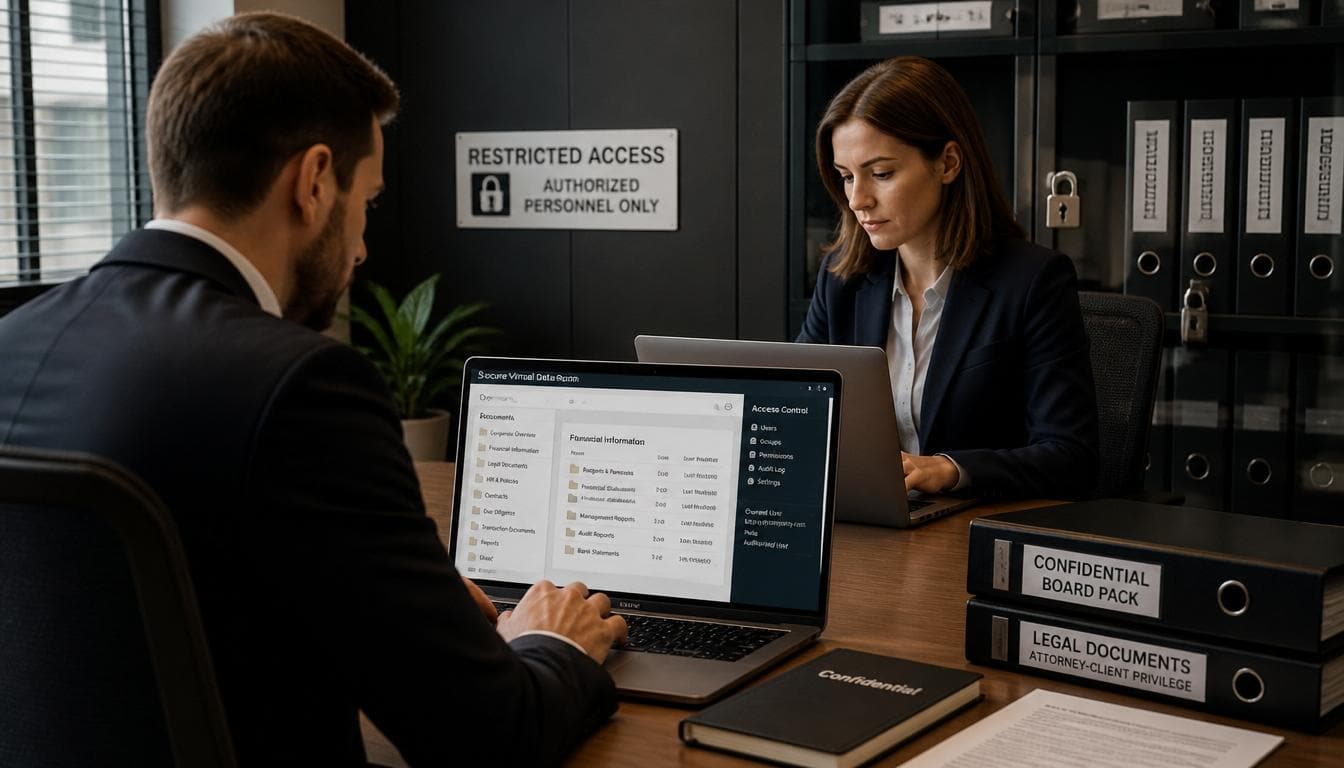
Virtual Data Room Security: Key Features to Look For
Every data room provider claims to be secure. The word itself has become close to meaningless as a marketing term, which makes it hard for a buyer evaluating platforms to tell genuine security depth from a checklist of features that sound reassuring but don’t hold up under scrutiny. This guide breaks down the specific security features and certifications worth verifying before trusting a platform with sensitive transaction documents.

Encryption: In Transit and At Rest
Two separate things need to be encrypted, and it’s worth confirming both explicitly rather than accepting a general claim of ‘bank-level encryption.’ Data in transit — moving between a user’s browser and the platform’s servers — should use TLS 1.2 or higher. Data at rest — stored on the provider’s servers — should use AES-256 encryption, the current industry standard. A platform that can’t specify which standards it uses for each is worth questioning further.
Granular Access Permissions
Security isn’t just about keeping outsiders out — it’s about controlling exactly what each authorized user can see once they’re in. Look for permission systems that allow control down to the individual document or folder level, not just broad tiers like ‘viewer’ versus ‘admin.’ The ability to restrict printing, downloading, or forwarding on a per-document basis is a meaningful differentiator between basic and genuinely secure platforms.
Dynamic Watermarking
Watermarking that embeds the viewer’s name, email, IP address, and timestamp directly onto every page — visible on screen and in any screenshot or printout — is a strong deterrent against unauthorized document sharing. Static watermarks (a generic ‘confidential’ stamp) offer far less protection, since they can’t be traced back to a specific viewer if a document leaks.
Comprehensive Audit Trails
A genuinely secure data room logs every meaningful action: who viewed which document, for how long, whether they downloaded or printed it, and from what IP address or location. This isn’t just a security feature — it’s often required as evidence in the deal itself, particularly if a dispute arises later about what a party did or didn’t have access to during due diligence.
- Document-level view and download history
- Login attempts, including failed logins and unusual access locations
- Permission changes, including who granted or revoked access to whom
- Exportable audit reports for compliance or legal purposes
Two-Factor Authentication and Access Controls
Password-only access is no longer sufficient for sensitive transaction documents. Two-factor authentication should be a baseline expectation, not a premium add-on. Beyond that, look for IP restriction options (limiting access to specific networks or locations) and the ability to set access expiration dates automatically, so reviewer permissions don’t linger indefinitely after a deal closes or falls through.
Compliance Certifications Worth Checking
Certifications don’t guarantee security on their own, but their absence is a meaningful gap. The certifications most relevant to data room providers include:
- SOC 2 Type II — independently audited controls around security, availability, and confidentiality, verified over time rather than at a single point
- ISO 27001 — an internationally recognized information security management standard
- GDPR compliance — relevant for any deal involving parties or data subjects in the EU
Ask providers directly for their current audit reports rather than accepting a badge on their marketing page — certifications expire and need to be renewed annually.
Physical and Infrastructure Security
Beyond the software layer, the underlying infrastructure matters. Reputable providers host on infrastructure with strong physical security controls and redundancy — most modern platforms run on major cloud infrastructure providers with their own independent security certifications, which is generally a stronger signal than a provider running its own smaller-scale servers.
Questions to Ask Before Choosing a Platform
- What encryption standards are used, both in transit and at rest?
- Can permissions be set at the individual document level, not just broad user tiers?
- Is watermarking dynamic and tied to the individual viewer?
- What does the audit trail capture, and can it be exported for compliance purposes?
- What current, independently audited certifications does the platform hold?
A provider that answers these questions specifically and confidently is a stronger signal than any generic security claim on a features page.
Related Reading
Virtual Data Room Software: Key Features and How to Choose the Ideal Platform
Virtual Data Rooms for Due Diligence: A Complete Process Guide
The Definitive Guide to Virtual Data Rooms (VDRs)
