


A Complete Guide to Data Room Compliance and Regulations in 2024
In the modern deal-making landscape, the virtual data room (VDR) has replaced the dusty filing cabinet. Whether you’re navigating a high-stakes merger, an IPO, or a biotech licensing deal, your data room is the vault holding your organization’s most sensitive secrets. But a vault is only as good as its lock. Without strict adherence to data room compliance and regulations, that vault becomes a liability—a ticking time bomb of litigation risk and reputational damage.
At Data Room Insights, we’ve dissected the regulatory frameworks that matter most. This guide isn’t just a glossary of acronyms; it’s your roadmap to ensuring your due diligence process doesn’t end with a regulator knocking on your door.

Why Data Room Compliance Is Non-Negotiable
Gone are the days when “bank-grade security” was a marketing buzzword. Today, it’s a legal mandate. A generic file-sharing tool like Dropbox or Google Drive lacks the granular controls required by modern regulators.
True compliance in a VDR context rests on three pillars:
- Data Sovereignty: Where is the data physically stored? (Crucial for GDPR).
- Access Control: Not just who can see a file, but what they can do with it (print, download, screenshot).
- Audit Integrity: Unalterable, timestamped logs that hold up in a court of law.
If a VDR provider tells you they are “secure” but hesitates to show you their third-party audit reports (like SOC 2), you are taking a gamble. And in the eyes of regulators like the SEC or the EU’s data protection board, ignorance is not a defense.
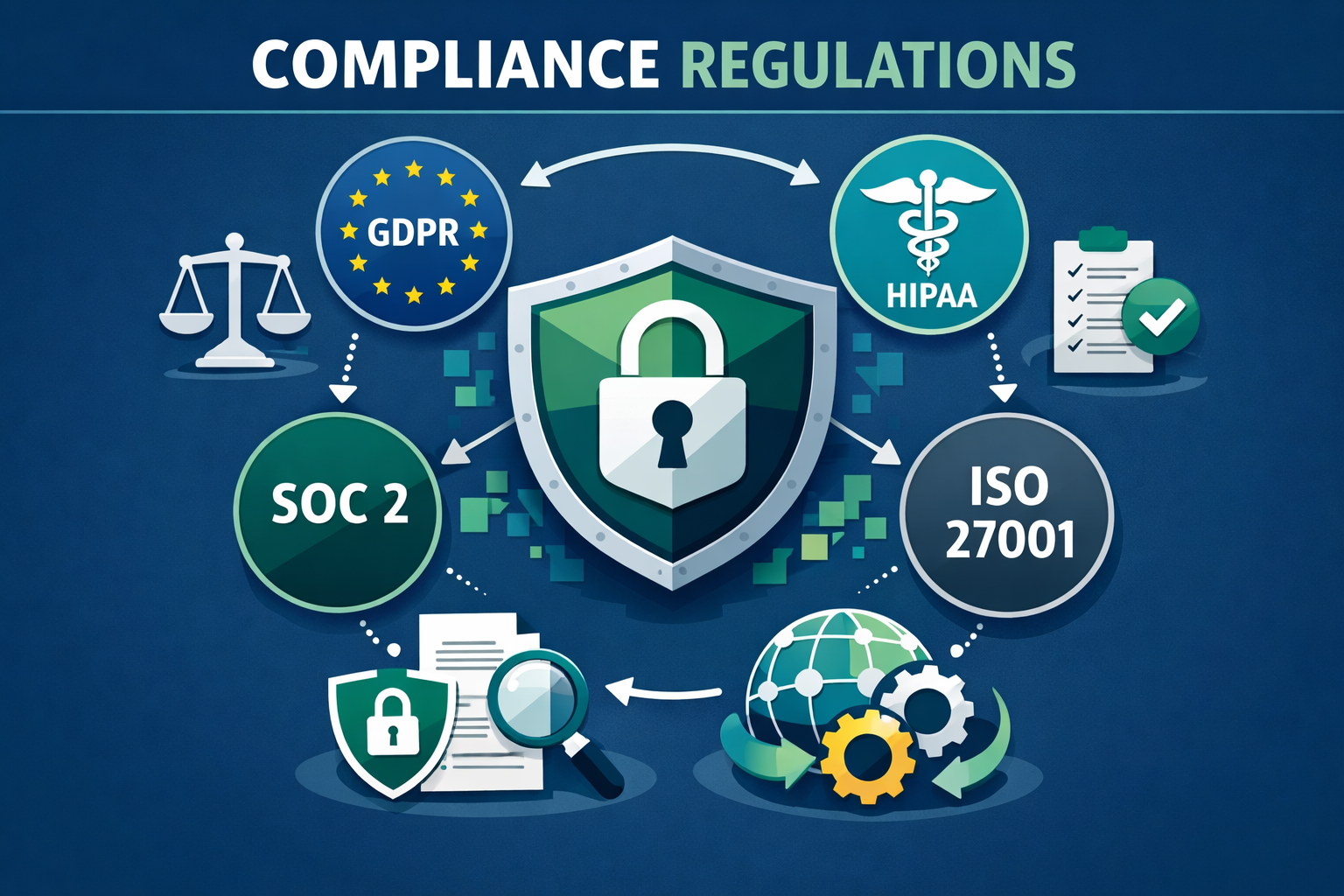
The Big Four: Regulatory Frameworks Shaping VDRs
To understand data room compliance, you must map your transaction to the relevant laws. Here is how the major frameworks interact with your virtual data room.
1. GDPR (General Data Protection Regulation)
If your transaction involves a European entity, a European buyer, or any European citizen’s personal data, GDPR applies. The “extraterritorial” nature of this law means even a U.S.-only fund buying a German asset must comply.
- The VDR’s Role: Your data room must enforce “Privacy by Design.” This means redaction tools become your best friend. Before you upload an HR document containing health information or a customer list with personal emails, you must anonymize it.
- The Localization Trap: Many providers claim GDPR compliance but store data on global servers without proper Standard Contractual Clauses (SCCs). Always ask: Is the data at rest in the EU?
2. HIPAA (Health Insurance Portability and Accountability Act)
For healthcare M&A, pharma licensing, or any transaction involving Protected Health Information (PHI), HIPAA compliance is mandatory. Google Drive can technically sign a Business Associate Agreement (BAA), but it lacks the dynamic watermarking necessary to prevent a data leak.
- Beyond the BAA: A compliant VDR for HIPAA doesn’t just sign the agreement; it forces two-factor authentication on all guest viewers and auto-expires access to PHI after a review period ends. If a VDR allows a third-party bidder to download unprotected PHI, that breach must be reported to the Department of Health and Human Services within 60 days.
3. SOC 2 Type II
SOC 2 is the gold standard for SaaS security, yet it’s widely misunderstood. A SOC 2 Type I report is a snapshot of the vendor’s security posture on a single day. A SOC 2 Type II report validates that controls functioned effectively over a period (usually 6-12 months).
- Why It Matters for Compliance: During sell-side due diligence, IT specialists from the acquiring firm will ask for your VDR’s SOC report. This proves that the confidentiality of the deal is mathematically guaranteed. If your provider only has a “self-attestation” of security, your deal is at risk of falling apart during the IT audit phase.
4. ISO 27001
This is the international standard for Information Security Management Systems (ISMS). While SOC 2 is more common in North America, ISO 27001 is a global badge. It proves the VDR provider applies a systematic approach to managing sensitive company information, including rigorous risk assessments and continuous improvement of security controls.
The “Insider Threat” and Dynamic Compliance Tools
When discussing data room compliance and regulations, executives often fixate on external hackers. Statistics suggest a more mundane but equally dangerous threat: the authorized user turning rogue.
A potential buyer might negotiate an acquisition, download a list of 10,000 customer profiles, then retract their bid and use that data to fuel a competing startup. A basic password-protected room cannot prevent this.
This is where Granular Permissioning shifts from a feature to a compliance requirement:
- View-Only Mode: Prevents download, print, and copy-paste.
- Fence View: Blacks out segments of a document except for a small, moving window controlled by the mouse. This prevents screen photography.
- Dynamic Watermarking: Embeds the viewer’s name, email, IP address, and timestamp on every page. If a document leaks, you can trace the source back to the second it was viewed. This is not just a deterrent; it’s forensic evidence.
The Cost of Non-Compliance: A Cautionary Tale
Consider a hypothetical cross-border M&A deal without a compliant VDR. A junior analyst shares an Excel sheet containing the home addresses of 5,000 EU-based employees via a public link to expedite a Q&A session. Under GDPR, that single link constitutes a data breach.
The consequences? A fine of up to €20 million or 4% of global annual turnover—whichever is higher. For large enterprises, the “4% rule” can dwarf the entire value of the transaction you are trying to close. Beyond fines, the deal timeline freezes as you scramble to contain the leak, often destroying the premium value of the asset.
Checklist: Ensuring Your VDR Meets Regulatory Muster
Before you populate your due diligence checklist with corporate documents, use this checklist to vet your provider’s data room compliance posture:
- [ ] Audit Trail Integrity: Can the exportable logs prove exactly who saw a document and for how long? Is this log admissible in litigation?
- [ ] Data Residency Options: Does the provider let you choose a specific AWS or Azure data center region (e.g., Frankfurt, London, Tokyo) for data sovereignty?
- [ ] Access Expiry Controls: Do links die automatically, or can “zombie users” linger long after the deal closes?
- [ ] AI and Machine Learning Clauses: If your provider uses AI to auto-index files, does that AI scan the content? If so, you might be feeding proprietary trade secrets into a public large language model. Ensure AI features are strictly local and opt-in.
- [ ] Vendor Lock-In/Exit Strategy: If you leave the provider, do you have the right to full deletion and a certificate of destruction? This is a key tenet of GDPR’s “Right to Erasure.”
The Future: AI Governance Meets the VDR
As we look toward the horizon, the conversation around data room compliance and regulations is evolving from pure privacy (keeping data hidden) to algorithmic governance. Regulators like the SEC are scrutinizing how AI tools inside VDRs influence deal outcomes. If an AI auto-summarizes a contract and misses a critical liability clause due to a “hallucination,” who is liable? The VDR provider, or the advisor using the tool?
At Data Room Insights, we predict that by 2025, compliant VDRs will not just log user actions, but log every prompt and response generated by embedded AI. This “chain of reasoning” will become a critical audit artifact.
Final Thoughts
In the high-pressure race to close a deal, security shortcuts can feel like efficiency gains. But regulators have no sympathy for the urgency of a Q4 close. Choosing a VDR is not an IT decision; it is a legal and strategic investment.
Never settle for a provider who is vague about their hosting region or unable to provide a live demo of their redaction and rights management tools. In the world of M&A, biotech, and legal diligence, your data room isn’t just storing files—it’s housing your corporate future. Ensure it’s built on a foundation of unwavering data room compliance and regulations.
Related Reading: The Executive’s Roadmap to Mergers and Acquisitions
Disclaimer: This article is for informational purposes only and does not constitute legal advice. Always consult with your legal team regarding regulatory requirements for your specific transaction.
