


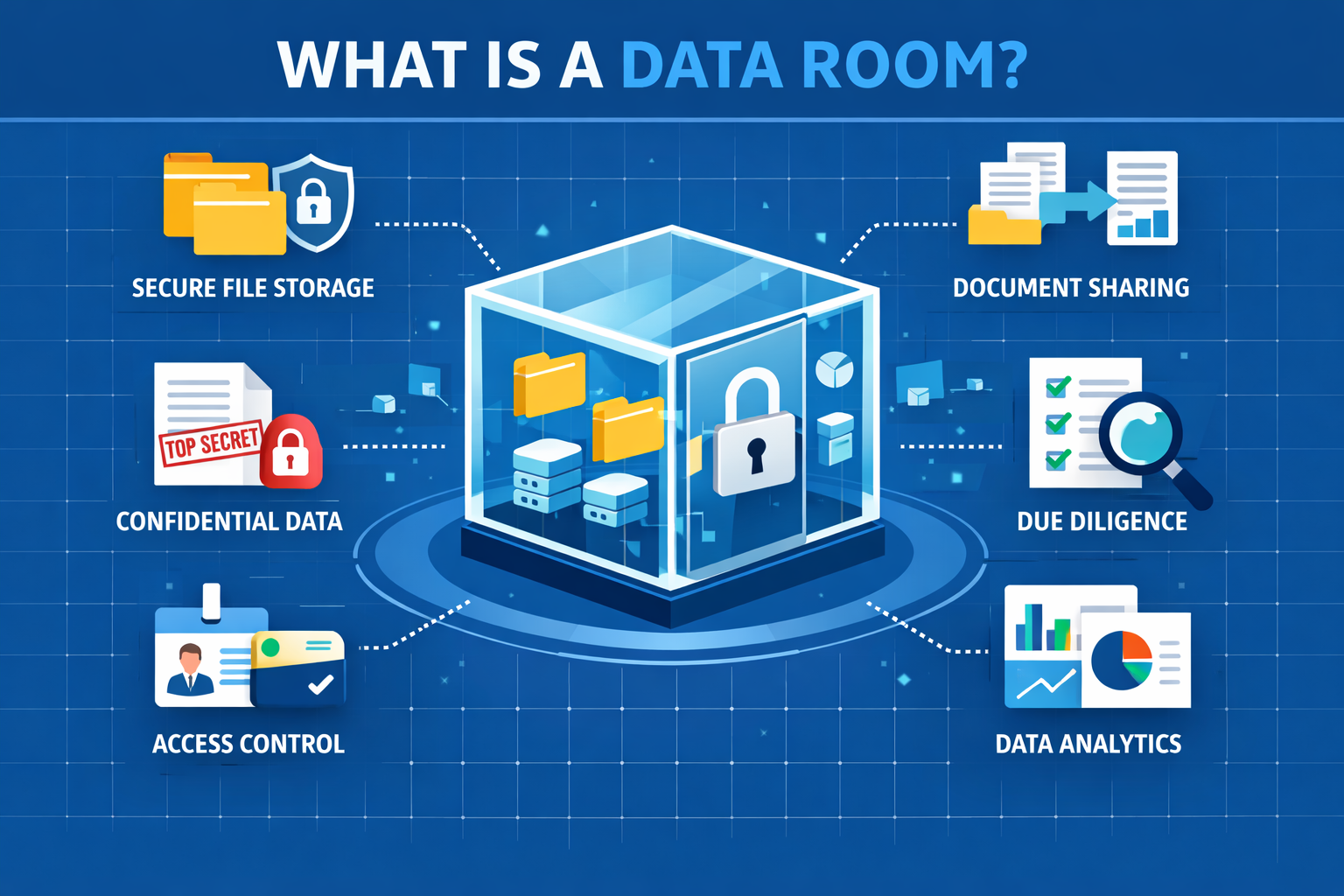
C But what is a data room, exactly, and why has it become such a fixture of modern business transactions?
In simple terms, a data room is a secure repository used to store and share confidential documents with a controlled group of people. Historically, that meant a physical, guarded room filled with filing cabinets. Today, it almost always means something far more practical: a virtual data room, accessible from anywhere, with far tighter control over who sees what.
This guide breaks down exactly what a data room is, how it evolved into virtual data, and why it has become essential infrastructure for deals, diligence, and disclosure.

The Original Data Room: A Physical Concept
Before the internet made document sharing trivial, a data room was literally a room. Lawyers, bankers, and potential buyers would travel to a company’s headquarters, sign in, and review paper files under supervision — often for hours at a time, with no ability to take copies home.
This physical model had obvious drawbacks:
- Geographic friction — every reviewer had to be physically present
- No real audit trail — it was nearly impossible to know exactly who viewed which document, and when
- Slow due diligence — deals often stretched on simply because access to information was so constrained
- High cost — staffing, security, printing, and travel added up quickly
As deals became more international and time-sensitive, this model simply couldn’t keep pace.
Enter the Virtual Data Room
A virtual data room (VDR) replicates — and vastly improves on — the function of the physical data room, but entirely online. Instead of a guarded room, you get a secure, cloud-based platform where documents are uploaded, organized, and shared with permissioned users under strict access controls.
Virtual data has fundamentally changed how due diligence, compliance, and disclosure work. Instead of scheduling in-person reviews, a bidder in Singapore and a legal team in London can review the same folder structure simultaneously, with every click logged.
At its core, a virtual data room typically includes:
- Granular permissions — control who can view, download, print, or edit specific folders and files
- Watermarking — dynamic watermarks tied to a viewer’s identity discourage leaks
- Audit trails — a complete log of who accessed what, and when
- Q&A workflows — a structured way for bidders or auditors to ask questions without email chaos
- Bulk upload and indexing — the ability to organize thousands of documents into a clear folder structure quickly
- Encryption — data is encrypted both in transit and at rest
Why Businesses Use Data Rooms
A data room isn’t just for massive corporate mergers. Virtual data rooms are now used across a wide range of scenarios:
Mergers and acquisitions (M&A): The most common use case. Sellers upload financials, contracts, IP documentation, and HR records so prospective buyers can conduct due diligence without ever setting foot on-site.
Fundraising and investment: Startups raising capital use data rooms to give investors organized access to cap tables, financial projections, and legal documents — all without emailing spreadsheets back and forth.
Audits and compliance reviews: Auditors need structured, traceable access to financial and operational records. A data room provides exactly that, with a clear record of what was reviewed.
Board communications: Sensitive board materials — minutes, strategic plans, financial reports — are often shared through a data room rather than email, where control over distribution is weaker.
IPO preparation: Going public involves an enormous volume of disclosure. A data room keeps every stakeholder — bankers, lawyers, auditors, regulators — working from the same organized, permissioned source.
Real estate transactions: Property portfolios, leases, and title documents are increasingly managed through data rooms during large commercial property deals.
Data Room vs. Regular File Sharing: Why It Matters
It’s tempting to ask: why not just use Google Drive or Dropbox? The answer comes down to control and accountability.
Standard cloud storage tools are built for collaboration, not for confidential disclosure under scrutiny. A data room adds the layer of control that a deal genuinely requires:
- You can restrict a specific user to “view only,” with no download or print rights
- You can revoke access instantly, even for previously shared files
- You get a defensible audit trail if a dispute arises later about who saw what
- You can apply dynamic, per-user watermarks that discourage leaks
- You can expire access automatically once a deal closes or a deadline passes
For a casual internal document, a shared drive is fine. For information that could materially affect the value of a company — financials, IP, contracts, litigation history — a purpose-built data room is the standard expectation from buyers, investors, and auditors alike.
How a Typical Data Room Is Structured
Most data rooms follow a similar organizational logic, usually mapped to due diligence checklists:
- Corporate documents — incorporation records, cap tables, board minutes
- Financials — statements, tax filings, projections
- Legal — contracts, litigation history, IP registrations
- HR — employment agreements, org charts, benefits summaries
- Commercial — customer contracts, supplier agreements
- Operations — insurance, licenses, compliance records
A well-organized data room dramatically speeds up due diligence, because reviewers aren’t chasing down missing documents or waiting on email replies.
Choosing the Right Data Room for Your Needs
Not every data room is built the same way, and the right choice depends on what you’re using it for. A small fundraising round has very different requirements from a nine-figure acquisition. Key things to evaluate include security certifications, ease of setup, permission granularity, support responsiveness, and pricing structure — all of which we cover in depth in our guide to choosing virtual data room software.
Final Thoughts
A data room, whether physical in origin or virtual in practice, exists to solve one core problem: how do you share highly sensitive information with the right people, and only the right people, while keeping a clear record of everything that happens along the way?
Virtual data rooms have made this process faster, more secure, and vastly more scalable than the old model ever could be. Whether you’re preparing for an acquisition, raising a funding round, or simply need a defensible way to share confidential records, understanding how a data room works is the first step toward using one effectively.
Next up: Read our guide on virtual data room software features and how to choose the right platform for your next deal and top data room providers 2026
