

The Business Imperative of Data Compliance and Information Governance
Navigating GDPR, SOC 2, and the Global Regulatory Maze
Introduction: From Red Tape to Revenue Driver
For decades, compliance was the department of “no.” It was the cost center that slowed down innovation, the team that returned your marketing campaign covered in red ink, the obligatory training module everyone clicked through as fast as humanly possible. Compliance was viewed as a tax on doing business—necessary to avoid jail time, but devoid of any strategic value.
That era is over.
We now operate in a business environment where a single data breach can erase billions in market capitalization overnight. Where an acquiring company will walk away from a deal—or slash the purchase price by 20%—if the target’s data house is not in order. Where a violation of the General Data Protection Regulation (GDPR) can cost a company 4% of its global annual turnover. In this world, compliance is not a cost center. It is the highest form of trust currency a company can hold.
> “Compliance and regulations in a business context refer to the framework of laws, standards, and internal policies that govern how organizations collect, store, process, secure, and dispose of sensitive data. This framework spans global privacy laws like GDPR, security attestations like SOC 2, industry-specific mandates like HIPAA, and the architectural principles—such as encryption and access controls—that transform legal obligations into operational reality.”
Consider the mechanics of a modern merger and acquisition. The buyer’s due diligence team does not just look at profit margins. They scrutinize the target’s compliance posture. Has the company ever suffered a breach? Are its data processing agreements with vendors in order? Is there a ghost server in a closet in a satellite office storing unprotected employee Personally Identifiable Information (PII) that would trigger mandatory breach notification laws if discovered? Finding skeletons in the compliance closet gives the buyer negotiation leverage. Worse, it introduces existential closing risk.
Thesis Statement: In the digital economy, a robust compliance and regulatory posture is not merely a legal shield—it is a competitive advantage that accelerates transactions, protects valuations, and builds enduring trust with customers, partners, and investors.
1. The Global Regulatory Patchwork: Why This Is So Hard
Before we dissect individual regulations, it is crucial to understand the structural challenge that makes compliance so complex for modern businesses: extraterritoriality and fragmentation.
The Extraterritorial Reach of Law
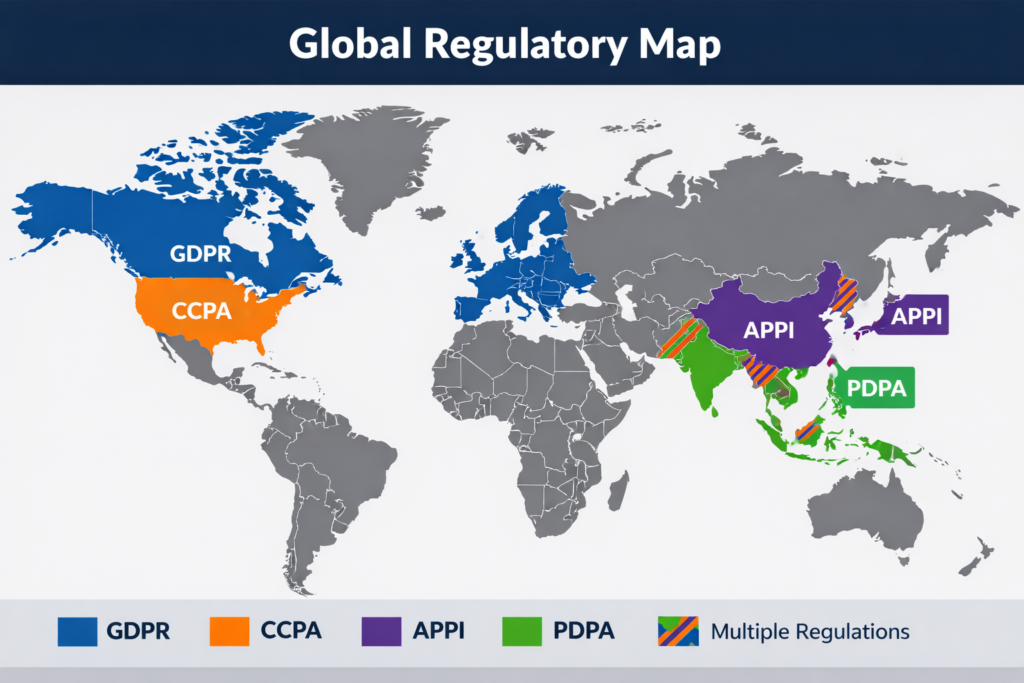
The internet does not respect borders, but laws absolutely do—and they increasingly claim jurisdiction far beyond them. Consider a practical scenario: A US-based company acquires a German subsidiary that sells software to customers in Japan. The customer data sits on servers in Singapore, managed by an Indian IT support team.
Which law applies?
– The GDPR applies because the subsidiary is in Europe and the data concerns European citizens.
– The California Consumer Privacy Act (CCPA) may apply if any of those customers are California residents.
– Japan’s Act on the Protection of Personal Information (APPI) applies to the Japanese customers.
– Singapore’s Personal Data Protection Act (PDPA) governs the processing on the servers.
This single, common business scenario triggers a cascade of overlapping, and sometimes conflicting, legal obligations. Compliance is not about satisfying one law; it is about architecting a system that satisfies the most stringent requirements of all applicable regimes simultaneously.
The Velocity Gap
The pace of regulatory change is accelerating. The European Union passed GDPR in 2016 (enforced 2018). California passed CCPA in 2018 (enforced 2020), then amended it with the CPRA in 2020. Since then, over a dozen US states have passed comprehensive privacy laws, each with unique definitions and thresholds. Keeping pace manually is impossible; compliance must be embedded into the technological and process DNA of the organization to be sustainable.

2. Deep Dive into Critical Regulatory Frameworks
Every executive involved in strategic transactions, data governance, or technology procurement must possess working literacy in the following frameworks. These are the standards against which your company will be judged.
The General Data Protection Regulation (GDPR)
The GDPR is the global gold standard for privacy regulation. It applies to any organization—anywhere in the world—that processes the personal data of individuals located in the European Economic Area (EEA). Its core principles are lawfulness, fairness, transparency, purpose limitation, data minimization, accuracy, storage limitation, integrity, and confidentiality.
Key Implications for Transactions and Operations:
– Data Subject Access Requests (DSARs): Any individual can demand to know what data you hold on them, how you use it, and to receive a copy of it. In an M&A context, imagine a DSAR arriving mid-diligence, revealing that the target company has decades of unstructured, unencrypted employee and customer PII scattered across local hard drives and legacy systems. This is a nightmare scenario that can pause a deal.
– Legal Basis for Processing: You cannot process personal data without a valid legal basis (consent, contractual necessity, legitimate interest, legal obligation, vital interests, public task). Consent must be freely given, specific, informed, and unambiguous—a dramatically higher bar than pre-ticked boxes.
– Cross-Border Data Transfers: Transferring personal data outside the EEA requires a valid transfer mechanism. The EU-US Data Privacy Framework (the successor to the struck-down Privacy Shield) is now in effect for certified US companies. The alternative mechanism is the Standard Contractual Clauses (SCCs), legal clauses incorporated into data processing agreements that bind the data importer to EU-equivalent protections. Following the *Schrems II* ruling, companies relying on SCCs must conduct a Transfer Impact Assessment (TIA) to verify the protections are effective in practice.
– Data Breach Notification: In the event of a personal data breach, you must notify the relevant supervisory authority within 72 hours of becoming aware. For high-risk breaches, you must also notify the affected individuals without undue delay. Your VDR and email systems must be capable of supporting this rapid forensic response.
SOC 2 (Service Organization Control 2)
SOC 2, developed by the American Institute of CPAs (AICPA), is not a law but an attestation standard—and it is the single most important certification for technology vendors, including Virtual Data Room providers.
The Five Trust Service Principles:
SOC 2 reports evaluate a service organization’s controls against one or more of these five criteria:
1. Security: Protection against unauthorized access and disclosure.
2. Availability: The system is operational and accessible as committed.
3. Processing Integrity: System processing is complete, valid, accurate, timely, and authorized.
4. Confidentiality: Confidential information is protected as committed.
5. Privacy: Personal information is collected, used, retained, disclosed, and disposed of in conformity with the organization’s privacy notice.
Type I vs. Type II: The Critical Distinction
– Type I Report: Describes the design of controls at a specific point in time. It says, “We designed a good lock.”
– Type II Report: Tests the operating effectiveness of those controls over a sustained period (usually 6-12 months). It says, “The lock worked consistently for a year. Here’s the proof.” A SOC 2 Type II report is the gold standard and a non-negotiable requirement for any VDR provider serving enterprise or regulated clients.
HIPAA (Health Insurance Portability and Accountability Act)
For life sciences, biotech, and healthcare companies, HIPAA compliance is foundational. HIPAA governs Protected Health Information (PHI)—any individually identifiable health information held by covered entities and their business associates.
In a transaction context, a biotech company sharing clinical trial data with a potential pharmaceutical acquirer must ensure its VDR is HIPAA-compliant. This requires the VDR provider to sign a Business Associate Agreement (BAA), legally binding them to safeguard the PHI and report any security incidents. Sharing PHI through a non-compliant platform is not just a contractual breach; it is a federal violation carrying significant civil and criminal penalties.
The US State-by-State Privacy Patchwork
With the absence of a comprehensive federal privacy law, states are filling the void. This creates a complex compliance map.
– California (CCPA/CPRA): Grants consumers the right to know, delete, correct, and opt-out of the sale and sharing of their personal information. Applies to a broad range of for-profit businesses.
– Virginia (VCDPA): Modeled closely on GDPR, with rights of access, correction, deletion, and opt-out from targeted advertising.
– Colorado, Connecticut, Utah, and many more: Each law has unique thresholds, exemptions, and consumer rights. A company doing business across the United States must build toward the strictest common denominator.
Industry-Specific Giants: SOX and Financial Services
– Sarbanes-Oxley Act (SOX): For public companies, SOX mandates strict internal controls over financial reporting. During M&A due diligence, the buyer will assess the target’s SOX compliance, as acquiring a company with material weaknesses in financial controls exposes the acquirer to significant regulatory risk post-close.
– Financial Services (GLBA, SEC, FINRA): The Gramm-Leach-Bliley Act governs financial institutions’ handling of non-public personal information. SEC and FINRA regulations impose specific cybersecurity and record-keeping requirements. Any VDR serving this sector must accommodate these unique compliance burdens.

3. The Architectural Blueprint of a Compliant Tech Stack
Compliance is not a policy document on a shelf. It must be architected into the technology stack, particularly for platforms used to share sensitive data.
The Certifications You Must Demand
When evaluating any third-party platform—especially a VDR—demand to see the evidence, not just the logos.
– ISO 27001: The international standard for an Information Security Management System (ISMS). It requires a systematic approach to managing sensitive company information. A current ISO 27001 certificate provides foundational assurance.
– SOC 2 Type II Report: As discussed, demand the full report, not just the certificate. Review the scope, the testing period, and any noted exceptions.
– FedRAMP (Federal Risk and Authorization Management Program): If you deal with the US federal government, the VDR must be FedRAMP authorized, indicating it has met a rigorous set of cloud security standards.
Data Center and Infrastructure Hardening
The physical and network architecture matters.
– Physical Security: Biometric scanners, mantraps, 24/7/365 camera surveillance, and security guards.
– Network Redundancy: N+1 power and cooling, geographically disparate disaster recovery sites with real-time data replication.
– Data Residency Options: The ability to select, in advance, the specific legal jurisdiction (e.g., Frankfurt, London, Sydney, Tokyo) where the primary data will reside. This is essential for satisfying GDPR and other sovereignty laws.
“Secure by Design” Feature Set in a VDR
The VDR itself must contain baked-in compliance features:
– Principle of Least Privilege: Users are granted only the minimum access necessary to perform their specific role. This is enforced through the granular permission matrix.
– Immutable Audit Logs: The system must produce a time-stamped, unalterable record of every action taken on every document. This serves as the chain-of-custody evidence if a regulatory body investigates a leak or breach.
– Automated Retention Policies: The VDR should allow administrators to set document and project-level retention schedules. Once a project concludes, the system can automatically enforce a data disposal schedule, preventing the accumulation of “zombie data” that creates unnecessary legal exposure.
4. Compliance in Action: The Deal Lifecycle
Regulations do not pause because you are doing a deal. In fact, the risk is heightened.
During the Diligence Phase
– Automated Redaction of PII: Before loading a single HR document into the VDR, the sell-side compliance team must redact all PII—social security numbers, dates of birth, personal bank details, health information. Modern VDRs with AI-powered redaction can scan thousands of documents and automatically strip this data, saving hundreds of paralegal hours and dramatically reducing the risk of a GDPR violation.
– Erecting Ethical Walls: A significant portion of deals involve a buyer who is a direct competitor. The VDR’s information barrier functionality allows the seller to wall off the commercially sensitive “crown jewel” data (pricing sheets, customer lists, manufacturing costs) in a separate section of the room accessible only to the buyer’s outside counsel and a clean team of economic consultants. This satisfies antitrust concerns and protects the seller’s commercial interests if the deal fails.
– Managing Insider Trading Risk: Under regulations like the SEC’s Regulation Fair Disclosure (Reg FD) in the US and the Market Abuse Regulation (MAR) in the EU, selectively disclosing material non-public information (MNPI) to some potential buyers but not others, or to market participants, is illegal. The VDR’s audit trail and Q&A module, where answers are published to all bidders equally, are critical controls against insider trading risk.
During the Post-Closing Phase
– Data Retention and Destruction: The SPA will contain a clause requiring the buyer (and sometimes the seller) to destroy or return all confidential information shared during diligence. A compliant VDR makes this a structured, executable process rather than a hope. The administrator can formally close the project and initiate a documented data purge, with a certificate of destruction serving as the legal proof of compliance.
– Ongoing Earn-Out Compliance: If part of the purchase price is an earn-out based on post-close financial performance, the VDR often transitions into a secure portal for sharing the audited financial calculations and supporting evidence. This prevents disputes and provides a clean, compliant audit trail for the earn-out period, which can last years.
5. The Cost of Non-Compliance: Beyond the Fine
When making the business case for compliance investment, the conversation often starts and stops at regulatory fines. This is a strategic error. The fines, while severe, are often the smallest expense.
The Three Layers of Cost
1. Regulatory Fines: Under GDPR, supervisory authorities can impose fines up to €20 million or 4% of global annual turnover, whichever is greater. These fines are not hypothetical; they are regularly issued against major corporations and, increasingly, mid-market companies. HIPAA violations carry civil penalties tiered by culpability, reaching over $1.9 million per calendar year for willful neglect violations.
2. The Deal Discount (Value Erosion): In M&A, non-compliance discovered during due diligence is a direct lever for the buyer to reduce the purchase price. The logic is simple: “We are inheriting a regulatory time bomb. We need a $5 million discount to cover the cost of the forensic audit, remediation, and potential fines.” This is the “clean-up discount.” It is a direct, immediate hit to shareholder returns caused entirely by preventable compliance failures.
3. Reputational and Business Continuity Damage: The long-term cost of lost customer trust, partner skepticism, and increased regulatory scrutiny often dwarfs the fine and the deal discount. A company known for playing fast and loose with data becomes an untouchable counterparty in high-stakes business.
6. Conclusion: Building a Culture of “Privacy by Design”
Compliance and regulatory adherence is not a project with an end date. It cannot be achieved by a one-time audit or by purchasing a specific piece of software. It is a cultural commitment to “Privacy by Design”—a framework that embeds data protection into the design of business processes and technologies from the very beginning, not as a bolt-on afterthought.
For companies that achieve this, the competitive benefits are tangible. They close deals faster because their data rooms are immediately auditable. They command higher valuations because their risk profile is demonstrably lower. They win enterprise contracts because their security posture clears procurement reviews without delay. They stop viewing regulations as red tape and start viewing them as a blueprint for building a trustworthy, enduring business.
The direct, causal link is unmistakable: clean, compliant data rooms enable faster due diligence, which builds buyer confidence, which reduces negotiation leverage, which protects and enhances exit multiples. Compliance, in the final analysis, is a revenue and valuation driver hiding in plain sight.
Call to Action: Do not wait for an acquirer’s forensic auditor to find the skeletons in your compliance closet. Conduct a data mapping and compliance gap analysis now. Assess your current data sharing platforms against the frameworks outlined here. The cost of proactive compliance is an investment in trust. The cost of reactive remediation is a preventable loss.
Frequently Asked Questions About Compliance and Regulations
Q: What is the difference between GDPR and SOC 2?
A: GDPR is a comprehensive data privacy law from the European Union that mandates how personal data of EU residents must be handled. SOC 2 is a voluntary attestation standard developed by the AICPA that evaluates a service provider’s internal controls for security, availability, processing integrity, confidentiality, and privacy. GDPR is a legal requirement; SOC 2 is a proof of operational excellence.
Q: What does a SOC 2 Type II report prove?
A: A SOC 2 Type II report proves that a service organization’s security controls are not only well-designed but have operated effectively over a sustained period (usually 6-12 months). It provides audited evidence of consistent control execution, making it the gold standard for vendor risk management.
Q: Why is a HIPAA Business Associate Agreement (BAA) important in a VDR?
A: If a healthcare or life sciences company shares Protected Health Information (PHI) during a transaction, the VDR provider is legally considered a Business Associate under HIPAA. A BAA is a binding legal contract that obligates the VDR provider to safeguard the PHI, report breaches, and comply with HIPAA’s Security and Privacy Rules. Without a signed BAA, sharing PHI with the VDR provider is a HIPAA violation.
Q: What is an “ethical wall” and when is it needed?
A: An ethical wall, or information barrier, is a technological segregation within a VDR that restricts access to specific highly sensitive documents to a limited group of individuals (typically outside legal counsel and a clean team). It is essential in deals where the buyer is a direct competitor, to prevent commercially sensitive data like pricing and customer lists from being exposed, which could violate antitrust law and damage the seller if the deal collapses.