


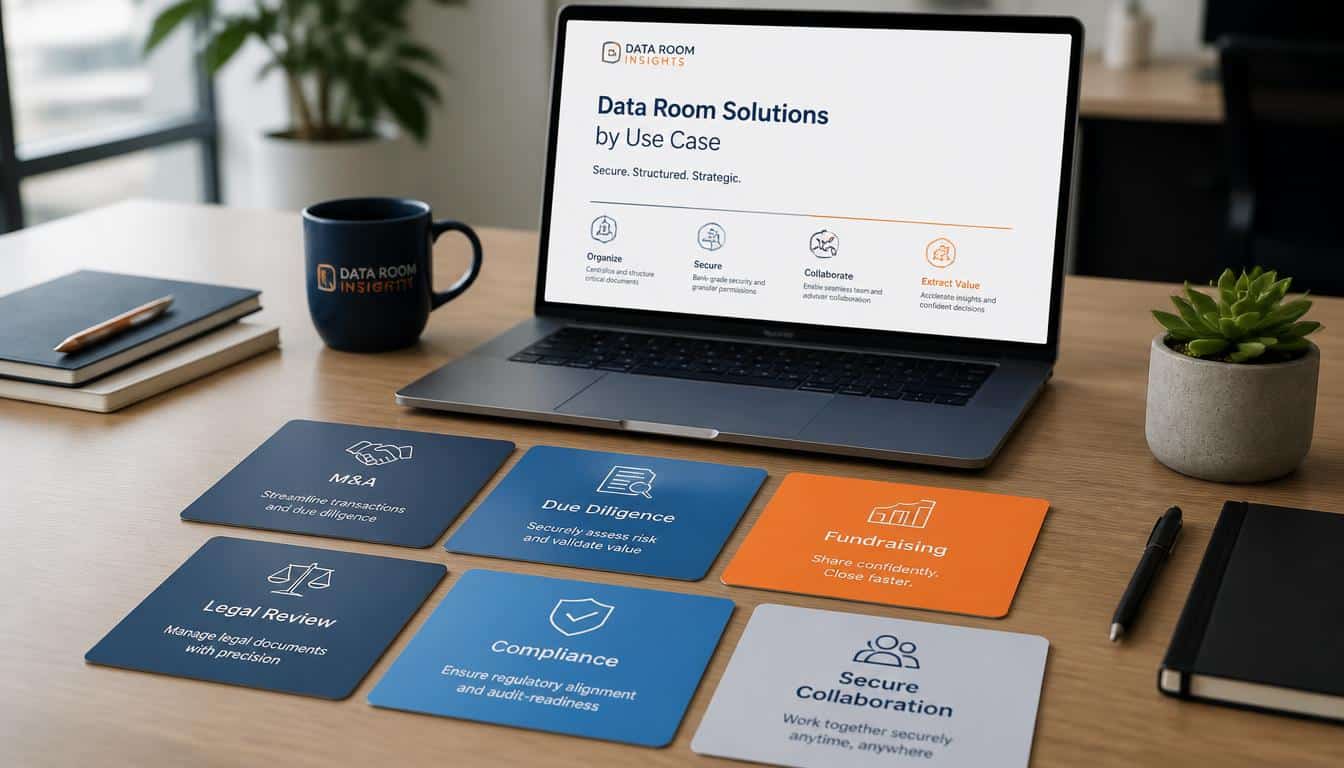
Data Room Solutions by Use Case: M&A, Private Equity, Real Estate, and Legal
Not every data room solves the same problem. A platform built to handle a fast-moving auction-style M&A process has different priorities than one supporting an ongoing private equity portfolio, and both look different again from what a real estate transaction or a legal case file actually needs. Choosing a data room solution based purely on a generic feature checklist misses this — the right platform depends heavily on what kind of work it’s actually going to do.
This guide breaks down data room solutions by the four use cases they’re most commonly built around, and what to prioritize in each.
Why Use Case Should Drive Your Choice
Most data room providers market a broad, general feature set — permissions, watermarking, audit trails, Q&A tools — and on the surface, many platforms look interchangeable. The differences that actually matter tend to show up in the details: how well a platform handles recurring, similar transactions versus one-off deals; how it manages document types specific to an industry; and which integrations and workflows are built in versus bolted on.
Matching a data room solution to your specific use case, rather than defaulting to whatever’s most popular in a general comparison, tends to produce a much better fit.
Data Room Solutions for M&A
Mergers and acquisitions are the most common use case, and most data room providers are built with this scenario as the primary design target. M&A-focused data room solutions typically emphasize:
- Staged access control, allowing sellers to release increasingly sensitive information as bidders progress through the process
- Structured Q&A workflows capable of handling hundreds of questions across multiple bidders without collapsing into email chaos
- Bidder segregation, ensuring competing parties can’t see each other’s activity within the room
- Engagement analytics, helping sellers understand which sections bidders are focusing on
- E-signature integration, supporting a smooth transition from final document review to execution
Because M&A deals are usually one-off, time-boxed transactions, project-based pricing tends to fit well, and most general-purpose providers serve this use case competently.
Data Room Solutions for Private Equity
Private equity firms have a meaningfully different pattern of use than a single M&A deal team: they’re often running multiple concurrent transactions, conducting recurring due diligence across a pipeline of potential acquisitions, and managing ongoing reporting to existing portfolio companies and limited partners.
For this use case, prioritize:
- Multi-room management from a single account, with the ability to view activity across several active deals at once
- Reusable templates and checklists, since PE firms frequently apply a similar due diligence structure across many target companies
- Annual or subscription-based pricing, which is typically more cost-effective than paying project rates for each individual deal
- Portfolio company reporting features, useful for firms that continue using the platform for LP communication after a deal closes, not just during acquisition
- Strong permission hierarchies, since PE firms often need to manage access across internal teams, portfolio company management, and external advisors simultaneously
Providers offering unlimited data rooms under a single subscription tend to serve this pattern far better than one-off, per-project platforms.
Data Room Solutions for Real Estate
Real estate transactions — particularly large commercial property portfolios — involve a different document mix than a typical M&A deal: title records, leases, zoning documentation, environmental reports, and property inspection files, often across many individual properties within a single portfolio transaction.
Real estate-focused data room needs include:
- Support for large volumes of scanned, image-heavy documents, since property records are frequently non-digital-native and require solid OCR and image handling
- Property-level folder structuring, allowing a portfolio deal to organize documents by individual asset rather than a flat document list
- Geographic and mapping integration, which some specialized providers offer to help reviewers navigate large multi-property portfolios more intuitively
- Long-term document retention, since real estate transactions and their associated records sometimes need to remain accessible well beyond a typical 90-day M&A deal window
Generalist data room platforms can handle real estate deals adequately, but providers with real estate-specific templates and property-organization features tend to reduce setup time significantly for portfolio-scale transactions.
Data Room Solutions for Legal Use Cases
Law firms and legal departments use data rooms for a wider range of purposes than transactional deal work alone — litigation document review, regulatory investigations, contract repositories, and confidential case file sharing among them.
Legal-specific priorities include:
- Strict chain-of-custody documentation, since legal use cases frequently require demonstrable proof of exactly who accessed which document and when, sometimes as evidence in its own right
- Privilege and confidentiality tagging, allowing documents subject to legal privilege to be clearly marked and access-restricted separately from general case material
- Long-term, indefinite storage options, since legal retention requirements often extend far beyond a typical deal timeline
- Granular redaction tools, given how frequently legal documents require careful, precise redaction of privileged or sensitive material before disclosure
Legal use cases often benefit from platforms with strong compliance certifications and detailed audit logging, since the data room’s record can itself become relevant evidence in litigation or regulatory proceedings.
Choosing the Right Solution: A Quick Framework
| Use Case | Priority Features | Pricing Fit |
| M&A | Staged access, Q&A workflows, bidder segregation | Project-based |
| Private Equity | Multi-room management, reusable templates | Subscription |
| Real Estate | Image/OCR support, property-level structuring | Project or subscription, longer retention |
| Legal | Chain-of-custody, privilege tagging, redaction | Long-term or indefinite retention |
When a Generalist Platform Is Still the Right Choice
Not every organization needs a specialized solution. A company running a single, straightforward M&A process doesn’t need private-equity-style multi-room management, and a small legal team handling occasional confidential document sharing may not need the full chain-of-custody rigor built for active litigation. In these cases, a well-regarded generalist platform, chosen based on the core criteria covered in our software buying guide, is usually the more practical and cost-effective choice.
Final Thoughts
Data room solutions aren’t one-size-fits-all, even though most providers present a broadly similar feature set on the surface. Matching your choice to how your organization actually uses a data room — a single time-boxed deal, an ongoing pipeline of transactions, a property portfolio, or a legal case archive — surfaces real differences in fit that a generic feature comparison alone won’t reveal.
Related reading:
- Virtual Data Room Software: Key Features and How to Choose the Ideal Platform
- Virtual Data Rooms for Mergers and Acquisitions
- Data Room Pricing
- Virtual Data Room for Startups
- The Executive’s Roadmap to Mergers and Acquisitions
- The Definitive Guide to Virtual Data Rooms (VDRs)
